
Telecom tariffs expected to fall from April 1st with TRAI lowering interconnection charges between two networks by 23-29 per cent.
The Association of Basic Telecom Operators has asked the telecom regulator to make access deficit charge available to all private basic operators for sustainability of fixed line business.

Meanwhile, new players like Etisalat, Unitech Wireless, Loop, STel and Sistema Shyam Teleservices -- who got the spectrum (radio waves) in 2008 -- paid Rs 80.78 crore (Rs 807.8 million) in spectrum charges and licence fees to the government.

Life has come full circle for Nobel laureate Professor Mohammad Yunus, who faced persecution during Sheikh Hasina's regime for embezzlement, is now all set to head of the interim government in Bangladesh after she resigned and fled the country.

According to data released by the telecom regulator, the wireless subscriber base increased from 635.51 million in June to 652.42 million by the end of July, 2010, registering a growth of 2.66 per cent.
Credible growth in new users was not matched by revenue as the all-India blended Average Revenue Per User per month for GSM remained almost at the same level of Rs 297 as compared with Rs 298 for the previous quarter.The ARPU for postpaid GSM service has shown an increase of 7 per cent from Rs 613 in January-March to Rs 655 in April-June quarter.

Regulator's nod assumed more importance after the Maggi issue.
The telecom regulator had suggested imposition of a price on operators for holding spectrum beyond the contracted limit of 6.2MHz.
The telecom regulator had on Monday said that for the first unsolicited communication, a service provider would have to pay a penalty of up to Rs 5,000, which could go up to Rs 20,000 for each subsequent call.
Telecom tribunal on Monday fixed April 2 as the date for hearing of petitions by Association of Basic Telecom Operators, Cellular Operators Association of India, Data Access and Bharti Telesonic against telecom regulator's IUC regime.
All cable operators will have to regulate the charging and billing procedure to follow the new telecommunication (broadcasting and cable) services (second) tariff (eighth amendment) order, 2007, from December 1, issued in a notification recently by the Telecom Regulatory Authority of India. According to the new regulations, every cable operator of a multi-system operator or a broadcaster will have to give to every subscriber the bill for the charges due.
The telecom regulator in the second ultimatum to GSM operators, including Bharti, Vodafone and BSNL, has given August 21 as the deadline to give interconnections to the RCom GSM network. Trai has cited it as a licencing condition to provide interconnection among the service provider implying if a mobile operator does not give interconnection to another based on mutual commercial agreement, it is a violation of license condition attracting penalty.

A department of telecommunication official said the regulator has already put questions relating to uniform licence fee to the stakeholder in its consultation paper 'Overall Spectrum Management and Review of License Terms and Conditions'.

Moving from pricing control to a free market means stiff competition.

Mobile tariffs are currently under forbearance, which means these are determined by market forces.
Every telecom service provider, who does not comply with the provisions of the regulations will be fined up to Rs 5,000 for the first instance. The operator could be fined up to Rs 20,000 every time the offence is repeated, Trai said in a release on Monday.
Telecom regulator Trai on Thursday said there will not be much impact on customers due to cancellation of 122 2G licenses of eight companies, as around 95 per cent of total subscribers belong to operators which got licences before January 2008.

However, Rajya Sabha being a continuing chamber is not subject to dissolution, and bills introduced and pending in this House remain on the live register, unless withdrawn by the government.

The regulator on Thursday asked the Mukesh Ambani-led Reliance Jio to withdraw the three-month 'complimentary' offer of unlimited data usage and free calls on payment of a minimum Rs 303.

Regulator wants the power to fine errant telecom companies.

Whether this happens because DGCA actually cares about the future of the national carrier or for other motives is not clear.

Last week, the Supreme Court refused to grant interim relief to the operators.

Telecom regulator TRAI on Tuesday suspended the newly-implemented norms for commercial text messages for one week, following major disruptions in SMS and OTP deliveries for banking, payment, and other transactions.
In a bid to promote competition in resale of bandwidth, the Telecom Regulatory Authority of India in its recommendations submitted to Department of Telecom has favoured not fixing any ceiling on the number of players in the segment.
Telecom Regulatory Authority of India is expected to issue the final consultation paper on full unification of telecom services before the end of February.
Trai contends that the issue does not come under the tribunal's jurisdiction.
A former chairman of TRAI on Friday told the JPC probing the 2G spectrum scam that the then NDA government did not seek the opinion of the telecom regulator on the issue of allocating "excess spectrum" to some private companies in 2002.

Demanding a level playing field for the old operators, Bharti group chief Sunil Mittal told PTI: 'our view is that the spectrum given to us and other operators from time to time is under a policy and there is no question of any additional payment for this.'
Leading mobile phone operators came down hard on the telecom regulator on a day when most saw their stocks on a crash course.

Sensex ended above 26,000 led by telecom shares amid TRAI's spectrum sharing norms.
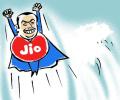
Jio had almost three times higher speed than its nearest rival Bharti Airtel.
The Department of Telecommunications (DoT) is likely to reject the telecom regulator's proposal to charge operators holding excess spectrum at a rate determined on the basis of the ongoing 3G bids.

Bharti Airtel on slammed telecom regulator TRAI's recommendations on spectrum fee, saying they are retrograde and arbitrary.
For the PMO this is urgent as the Digital India framework would depend on how the telecom companies perform. It is also linked to the proposed auction of 5G airwaves.
State-run BSNL has questioned the Telecom Regulatory Authority of India's powers and jurisdiction in matters relating to interconnection between the PSU and other private service providers.
 © 2026 Rediff.com - Advertise with us - Disclaimer - Privacy Policy - Sitemap - Feedback - About us - Terms of use - Grievances